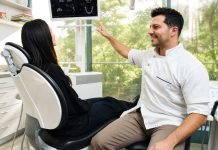
Alzheimer’s disease and poor oral health care go hand-in-hand, but as Samantha Trenoweth discovers, a new partnership addressing the joint issues is a force to be reckoned with.
 Alzheimer’s disease and poor oral health care go hand-in-hand, but as
“What’s fantastic is that consumers have identified this as an area that is important to them,” says Carol Bennett of a new initiative between Alzheimer’s Australia and the Australian Dental Association that will help dentists treat patients with Alzheimer’s disease and dementia.
Carol Bennett is chief executive officer of Alzheimer’s Australia. The project came about, she says, “because our consumers identified the priorities that they, as people living with dementia and their carers, felt needed to be addressed.” Dentistry and oral health came up as a significant area of concern.
There are 342,000 Australians currently living with dementia and, in years to come, that number is expected to grow. “So it’s really important,” says Bennett, “that dentists and other oral care professionals are aware of the issues facing people with dementia, and that they can relate to them in a way that helps them understand their dental care.”
The Australian Dental Association [ADA] has taken up the challenge. Associate Professor Matthew Hopcraft, from Melbourne University, is the chair of a committee that is developing resources for dentists and dental professionals to help them treat patients with dementia and Alzheimer’s Disease. Professor Hopcraft, when not starring in the 2015 season of Masterchef, has a special interest in disability medicine. “I did my PhD in oral health for people in nursing homes, so I have a bit of a background in this area,” he says.
The project is being funded by the J.O. & J.R. Wicking Trust, through Alzheimer’s Australia’s National Quality Dementia Care Initiative. And the steering committee includes a broad cross-section of affected people, including patients with dementia, social workers, carers and dental professionals.
“Nobody really knows what it is like to experience dementia except a person with it,” says Valerie Jenner, who cares for her husband, Bob Page, who was diagnosed with Alzheimer’s disease at age 59. Page and Jenner have been active members of the committee and are excited about the progress they’ve seen.
“I’ve been impressed by how keen the people at the ADA are, and their understanding is growing exponentially,” says Jenner. “Dentists can’t be with their patients who have dementia 24/7, so there’s a lot they don’t understand and they need some guidance on how to build successful relationships with them. We’re offering that guidance and I think it will lead to a very successful project. I hope more of these projects will follow. I think it’s a community awareness thing. The whole community needs to be aware of dementia and of how best to interact with people living with it in the community.”
“The focus will be on online training,” Professor Hopcraft explains. “We have 15,000 dentists spread around the country. It’s difficult for the Australian Dental Association to put on a travelling roadshow that would get to everyone, so developing online materials is the best way to ensure that every practitioner has access to them. We’re hoping that we will be able to supplement that online material with some face-to-face training as well.”
When patients develop dementia, it is in their interests to maintain continuity of care with their own dentist—and generally it’s in the dentist’s interests to maintain that relationship, too.
“It’s about patient management and understanding things from the point of view of the patient and the carer,” says Professor Hopcraft. “One of the central issues we’re addressing is how to approach a long-term patient who goes through the various stages of dementia. Some of the things that people with dementia have difficulty with are new things—new environments, new faces—and so continuity of care is really critical for these patients. That’s why it’s so important that we give dentists the tools to say, ‘I’ve been seeing Mrs Jones for the last 14 years and I know her oral health problems really well, and I know the sorts of things that she needs and it’s in her best interests for me to keep seeing her and it’s in my best interests to keep her as a patient.’”
Dementia and Alzeheimer’s are progressive diseases, so it is possible to set up a strategy for long-term care. Dentists, patients and carers can assess the level of self-sufficiency, the state of the patient’s oral health, their mobility and levels of mental and memory impairment. And ideally, in the early stages, the dentist, patient and carer can set up an oral-care strategy.
There’s a great deal of potential here for dentists, patients and carers to work together, implementing techniques that will help patients to take care of their own oral health for as long as possible. Different types of toothbrushes may provide better grips. A change to a higher-fluoride toothpaste might suit some patients. Memory lapses are a key issue in the early stages of dementia, so techniques to get around these can be discussed.
“We’re looking closely at the earlier stages of dementia when the patient is still living at home and cared for by a spouse or family member,” explains Professor Hopcraft. “There will be a little bit in the program about patients with more severe dementia, living in nursing homes and domiciliary care, but that is not our primary focus.”
One of the issues that has been identified by the committee is the disorientation and distress that can affect people living with dementia in new situations. To address this, dentists might need to adjust waiting rooms, so there is a special area in which these patients can sit. Or perhaps it will mean calling carers to let them know if appointments are running late, to minimise waiting time. There could be special training for dental assistants and receptionists, who may need to spend longer on the phone making an appointment and taking medical details from clients who have dementia. There are many, many small changes that a practice can make to ensure that these patients are comfortable.
“It’s not unusual, even for those of us with full cognitive capacity, to be a little intimidated when the dentist puts on his mask. It’s those sorts of things,” says Jenner. “A lot of the work that needs to be done is in gaining the confidence of the person with dementia. So dentists need to know not to rush the client into the chair, and it’s important that the first thing they see is not a dentist with their mask in place. We need the dentist to take the time to reassure the client, to explain procedures clearly, and sometimes more than once, to accept that they need to take a bit longer with someone with dementia and make allowances for that.”
“Respect is really important,” says Bennett. “People with dementia want to be treated just like everyone else. They don’t always understand what’s going on, and they want to know. They want to get information about what’s happening and why in a way that respects them and works with them. It’s about good communication and working with the person to achieve the best outcome. It’s about developing trust and respect. It may also be about working with the carer or it may be a follow-up phone call or letter. That will vary from person to person.
“It’s also about practical advice—talking with the patients about ways in which they might manage their oral health and working with them. We know that if dental health is not maintained, it can lead to all sorts of other health problems and it can also lead to pain. For people with dementia, communicating pain can be quite difficult. So it’s better to prevent that pain by maintaining good oral health.”
The main aim of the project is to help dentists better meet the needs of patients living with dementia, but Professor Hopcraft hopes that the project will also help dentists to educate carers about the importance of maintaining good oral care as dementia progresses. Ultimately, it falls to the carer to assess the patient’s ongoing oral health, to know when pain and discomfort need attention and to keep an eye on the condition of teeth.
“We will definitely be helping dentists to provide more knowledge to carers,” Matthew adds. “That education for carers is crucial, whether it’s in nursing homes or for carers who are looking after people with dementia in their own homes.”
This project not only has ambitious scope, it has an ambitious timeline as well. The online professional development program will be rolling out in the first half of 2016 and the committee hopes it will begin to make a tangible difference in the lives of both dentists and their patients with dementia right away. As Bob Page says: “We have to keep looking for better ways of doing things and we have to help people who can’t get into the places that we’re going, and who aren’t getting the help that we’re getting—whether people with Alzheimer’s or other people. We have to help.”