by Dr George Sakoutis, Odontologie Dental Care, Lansvale, NSW
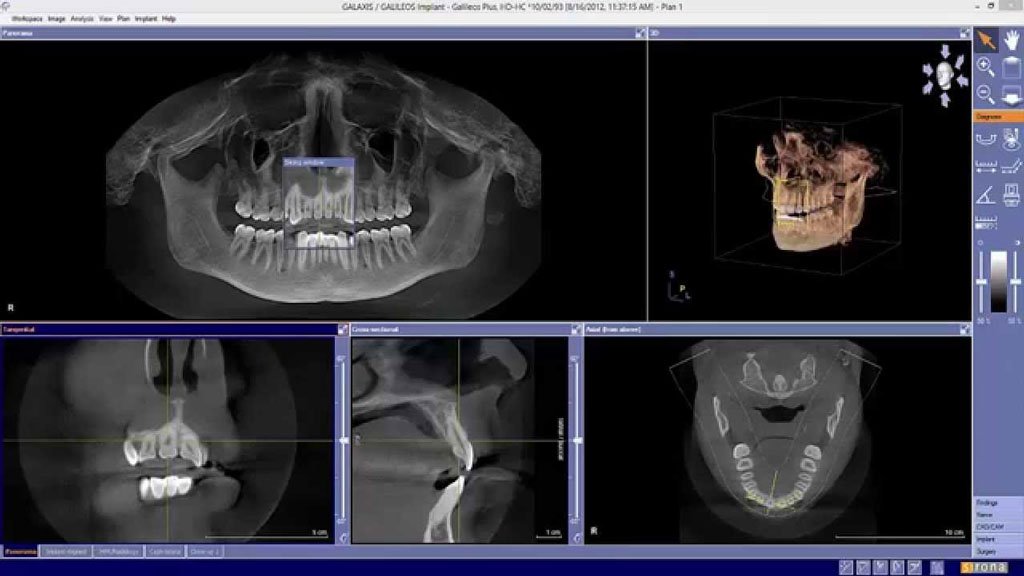
The main reason I like this technology is that it allows me to perform safer implant surgery. For many years, all we had to go on was a two-dimensional X-ray or an OPG X-ray. This cone beam system uses 3D technology that allows each implant to be placed with incredible accuracy.
What’s good about it
When finding the optimum position for the implant, all the anatomical structures are shown very clearly. You can ensure that everything is safe and you won’t hit a nerve or blood vessel, or perforate the buccal or palatal wall. Knowing that the implant can be positioned accurately and safely makes me feel much more secure.
Galileos not only shows the position of the implant but how it will exit the tooth. This means you can design a crown on the Cerec and transport that information back into the software program. All the anatomical variations are coloured with the nerve canal well described. With the crown shown in position on the model in the virtual viewer, you can make sure the implant is correctly positioned and also loaded in a nice position. Aesthetically, it’s very pleasing.
It’s also possible to mill a surgeon’s guide with the hole positioned very accurately. Any implant system can be driven through that hole and it will reproduce the result that was shown on the 3D image.
What’s not so good
It’s a closed system. It’s impossible to transfer outside the system or to import an X-ray or cone beam from a laboratory using a different system. It’s not a big issue but it would be much more efficient if all systems worked with each other.